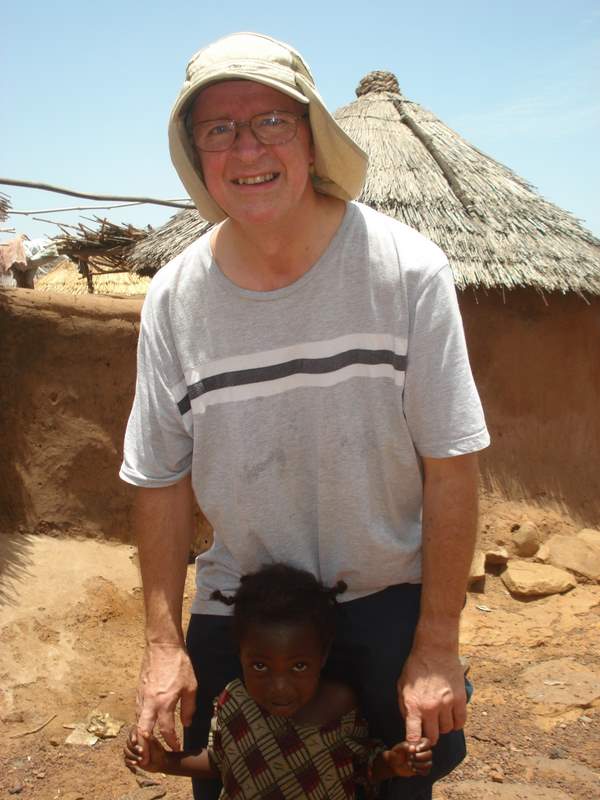
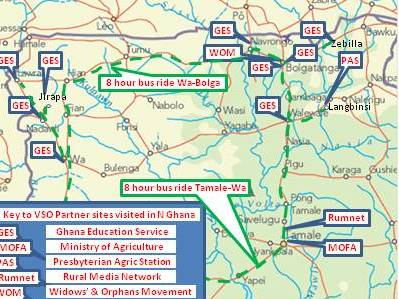
Mike's assignment with VSO working in Organisational Development (OD)

Friday, May 21, 2010

A week (mostly) in Walewale, and a Joint Introduction Meeting

We have an interesting time over the weekend communicating with a new VSO volunteer who may be coming to Walewale. Communication methods include email and then a phone call on the Sunday evening. I stick my neck out a little and make some suggested changes to the Placement Description that the new volunteer has been sent, and send this amended version to the potential new volunteer and to Dora the VSO Ghana Education Programme Manager and to Skev in the UK who arranges these education placements. Charlotte is too malarial to get into emailing, but does join in the phone call.

Once again I attend the Monday meeting  at the District Education Office on Charlotte's behalf. This week the value we're looking at is Teamwork, and Robert Kwame runs a little drama encountering various obstacles and needing help. In the picture he is being obstructed by an ant.
However, one disappointment is that the District Teacher Support Team meeting, which last week sounded so much on track, does not appear to have happened without Charlotte to remind the participants on the day. It's very hard to get people to treat a meeting as a commitment rather than just an invitation which they may or may not take up if they remember.
In the VSO Bolga office, here is Damien having an in-depth organisational development discussion with Jemimah. Probably. After last week's meeting in Accra I have agreed with Cath in Jirapa that she can be an Upper West supporter for Education, and Damien has agreed to support Education volunteers in Upper East and Northern Region. Jemimah is the supporter for the Participation and Governance programme area. And I should really be saying G-SAP (Guided Self-Assessment Process) rather than "organisational development" as that is the new VSO Ghana terminology. G-SAP will mean both the assessment and the subsequent development (i.e. "G-SAP" = "OD" in VSO Ghana).
Here are a few shots from the tro-tro going back to Walewale. It's all looking rather greener now that the rains have started.
In case you were wondering, "stool lands" probably refers to areas with traditional chiefs - e.g. "stool" is the equivalent of  "throne", and I have seen references to chiefs being "de-stooled" if not fit for office.
Next is a very exciting picture. The mains water had been off for some time, and our 200 litre "dustbin" of back-up water was down to its last day's worth (i.e. a couple of buckets). The water comes back just in time, and in the picture you can see that I'm able to fill it up again.
Friday is the Joint Introduction Meeting for Leticia, the Management Support Officer, and for half of Damien's role. Damien is regional gender support for two districts, Talensi Nabdam and here, i.e. West Mamprusi.
 
The Joint Introduction Meeting (JIM) is a gathering of people with an interest in the volunteer's objectives, in order to agree the objectives and work plan. The scene is set by the District Director of Education (see him clutching his new SMC/PTA manual). This is Charlotte's first day out of the house after being laid low with malaria. VSO overall aims of the Education programme are explained, and the volunteers present their proposed objectives.
The meeting is held at the District Assembly (= local council). I thought you'd like to see the facilities for hand-washing. Charlotte has a basin to wash her hands in, though half of the ceramic bowl is missing. However, this is a better facility than in the gentleman's toilets, where basin and taps are missing.
Anyway the meeting concludes with objectives and actions agreed.
But some school classrooms are still missing roofs after the April 22nd storm...

Friday, May 14, 2010

Malaria, Accra and malaria

Charlotte doesn't feel well enough to go out of the house on Monday, but on Tuesday we get her to hospital. One again our neighbour George comes to the rescue and takes us in.(For the record, the first picture is the drain that George's car fell into on the scorpion sting night, 22nd April).
The (Cuban) doctor rapidly diagnoses malaria, even though the blood test doesn't show anything. Charlotte's prescriptions are shown here, with the pills out of the bag being the ones she had to take straight away.
I am due to go to Accra on the 4pm bus on Tuesday, and Charlotte insists I should go because she has company and care from Andrea and Fati. So it's a 4 am arrival at the Sun Lodge where our in-Country Training took place in September. Below you can see Aidan's response when Terry had said "hands up who wants to volunteer for..."
Actually everyone volunteers for something. This is a meeting for those who want to tailor the organisational development tool/process further  (re-branded as Guided Self-Assessment Process) and/or take on, part-time the role I've been fulfilling of OD support. Present at the meeting are Aidan, Emily and Michael Pitt from Disability/Inclusion; Krista and Olke from Secure Livelihoods; Jemimah for Participation and Governance; and Michael Rubindayo and myself from Education. Michael R has experience from VSO Cameroon.  Plus of course Terry who is co-ordinating.
#
Conclusions from the meeting are reviewed later that afternoon and evening. This is also a chance to meet up with newly-arrived volunteers, including Dorien who will be Management Support Officer in Wa, so I fix to visit Wa in a visit to Upper West I'm planning in two weeks time.
I can't get a lunchtime bus the next day, but a great discovery is the OA VIP bus which has wider seats that recline more, for only 30 cedis (£15) rather than 24 cedis. Above is "Circle" (Nkrumah Circle,i.e. roundabout) in Accra. Next photo shows the view in Tamale at 5am - the world will end 21st May 2011, you heard it here first.
The bus arrives Walewale at 7am, which suits me much better than the typical 3 am arrival.
Charlotte is still not well, and I manage to fix transport to Tamale to the VSO-linked hospital there, Kabsad, and we both go expecting to stay. (The picture shows cattle crossing the main road North through Ghana). At Kabsad the test shows malaria parasites present, and some residual typhoid, so the little blighters have survived the first wave of drugs, which Charlotte has completed. So it's a new wave of prescriptions, but back to Walewale to recover.

Monday, May 10, 2010

An (extra) ordinary Monday morning at the office

Charlotte is unwell and has had a sleepless night, and I go in instead of her for the regular Monday morning meeting at the West Mamprusi District Education Office;  I have a couple of messages and notices from Charlotte e.g. she has been working with the GES  (Ghana Education Service) staff for some time on resurrecting the District Teacher Support Team, and there is a meeting on Wednesday people may need reminding about.

The Monday morning routine is very different from 6 months ago.

Then people would drift in, solemnly record 7.59 a.m. as their arrival time irrespective of the actual time, buy breakfast or other stuff from some of the traders who plied their wares in the office, and chat about the weekend.
Now people are in place for the morning meeting before it starts, and it starts early. After a prayer and a short moral message, the Assistant Director Finance, John,  who is chairing the meeting announces we are looking at the core values one by one. (The Director is in Accra). Last week it was Professionalism. This week it is Sharing Knowledge.
He gives some examples, and others do too. This gives me a great opportunity to fulfil one of my instructions and plug the School Management Committee / Parent Teacher Association Training Manual developed by VSO, and I refer to the SMC/PTA  trip by Charlotte, Robert, Ramatu and others to "Overseas" (see http://www.charlotteinghana.blogspot.com for late March). I'm able to plug the manual as an example of sharing knowledge across organisations. (I have copies for people if they'll pay for them to cover the photocopying costs).
Here are a few examples of other points covered. A.B.Mahama (Head-Teacher Adviser) gives a good briefing about the District Teacher Support Team meeting. (I was primed to remind people about this, but it's all in hand without my reminder, which is great). He explains there are still problems reconciling which school is in which cluster, but the group has worked on this and outstanding questions are with AD/Sup (Assistant Director, Supervision). A funding proposal has been submitted to TENI (this is what I was helping Charlotte with on April 22nd - the night of the scorpion sting). Next meeting will look at how the revitalised DTST will be re-launched with Head-Teachers - this is important and the DTST will co-ordinate all in-service training. Sirina, the Pre-School Development Adviser  explains some ideas from a teacher-training workshop she has been to about key development areas for kindergarten children. There is talk about sharing ideas with teachers more, and strong encouragement for "cluster-based in-service training" - i.e. take the training to the teachers in their own "clusters" of schools. Charles Sumani the Basics Schools Co-ordinator raises questions about teachers not at school which generates some useful discussion for Circuit Supervisors. There is an encouragement to Schedule Officers not to "entertain" teachers in the morning in the office when the teachers should be teaching - if teachers have problems and need to come into the office they should do this in the afternoon after classes. Someone observes that the Schedule Officers need to be in the office promptly in the afternoon in that case - recognised by the Chair as a very good point.
So the culture of this GES (Ghana Education Service) as a whole still has some way to go, sure. But this meeting sets a great tone for the week. It's purposeful, open, interactive, no-messing (someone starts to have a mobile phone conversation in the meeting and is summarily sent out - that's a change!), and has some real problem-solving going on. It is taking the values and making them real - I'm pleased about this, I'd suggested this to the Director and he's taken it up. And this purposeful meeting has become part of the new routine - and it happens like clockwork even though the Director isn't here. There is some way to go, but the impact of the Organisational Development is already very evident.
This is (now) an ordinary Monday morning meeting, but it's extraordinary what a change we have seen in 6 months.

These aren't the greatest pictures because I was trying to be unobtrusive taking them, but hopefully they illustrate the meeting. The Values statement with everyone's signatures is behind AD (Finance) - John -  the Meeting Chair. (The Director has now had the values added to the Office's letterhead).
But just as a reminder of the challenges the District is facing, here's another school with the roof blown off in the recent storms (see April 22nd and 30th entries).

By the end of the day Charlotte is feeling a little better, though not eating yet ...

Saturday, May 8, 2010

Visit to the Kukoa at Gambaga

We make a last-minute decision that this weekend we will visit the Kukoa ("witches' camp") at Gambaga. This is mentioned in the Ghana Bradt guide, and you can read more about it by Googling "Kukoa Gambaga". Also Canadian Maggie, who came to see us February 20th, wrote a great article in "The Advocate" in April after a visit to another kukoa out past Bimbilla (website for "The Advocate" - the development newspaper that Mar and Mark work on - is http://rumnet.wordpress.com and Ghana phone 0244-218898).
A quick summary is that women are sent to the kukoa after being used of witchcraft on a very arbitrary basis, e.g. illness or death of a child in the family. They are sent there for life. This 'imprisonment' has been challenged on humanitarian grounds, but when many of the women were 'freed' they refused to leave, as this has become their home.
We often meet new people on tro-tros. This time it's Agnes, from Norway, working in an orphanage in Nalerigu. We head east on a packed tro, but after Langbinsi there is more room. Charlotte was sitting beside what you would call a window if there was any glass in it. It gets dusty and she swaps with Fati. The part of the roof that's dangling is a little obtrusive. The seat in front of me tips forward rather readily, because although the seat is welded to the vehicle floor, that section of floor has broken off. 
The party is (left to right) Charlotte, Jacob, Mandina (who is Mashood's friend), Fati and Mashood. We're given a bench in the shade while waiting to see the chief. The kukoa is not separate from Gambaga as I had thought, but is right next to the rest of the town. Children as usual are delighted to see us.
We meet and pay the chief. Apparently the traditional gift of cola nuts is not really wanted any more, and hard cash is preferred. We compromise with 5 cedis in a handkerchief. This is supposed to benefit the women. However we give some more when we meet the women leaders of the "witches". They are very friendly and apparently happy people. I explain that we respect old people and recognise their wisdom - the women reply that they are happy to be alive. The stripy green shirt (see photo) is "South Africa 2010" so I  mime a little Ghana vs England football which is much appreciated.
Our "tour" seems to end rather rapidly, so I ask about the cultivated front gardens that I have read about. We don't see these, but we do get more of a walk around the kukoa. The place seems very well organised, a working community. The yellow nuts are dawa dawa nuts - spread out on the ground to dry. Firewood is neatly stacked. The whole area is tidy and clean - more so than most communities that we have seen in Ghana.  
As we head back we see a blacksmith making ploughshares and a goat being skinned.
Lunch in Nalerigu is fufu or rice balls, made and eaten under a tree by the side of the road. I opt for 3 rice balls (10 pesewas each) and 2 pieces of meat (20 pesewas each), total 70 pesewas (or about 30 pence in UK currency). The meat is guinea-fowl - there is a cage of more guinea-fowl awaiting their turn.
There is time for a look around the main square in Nalerigu and a drink in a local 'spot' (bar).
Then we find another decrepit tro-tro for the bone-shaking journey back to Walewale. Some local children are fascinated to talk to us "Sulaminga how are you" while we wait for the tro to fill.
Back in Walewale, look at the picture of the school (behind Charlotte in the photo, to the right of Mashood's Community Information Centre). The roof blow off in the storms of 22nd April (see blog entries April 22 and 30). Nothing has been done to fix it yet. The children will come back to school this week. The last time this classroom featured in this blog was December 16th when we taught each other a song in this room. We think that the children will be taught in the classrooms without a roof but be sent home when it rains - however they will have no protection from the sun
The view of the sky as we headed home.

The different paths to our VSO placements

THE PATH TO CHARLOTTES PLACEMENT

Jan 2009 - With 2 younger children still at university, Charlotte & I apply for short-term work with VSO. Both turned down - I think they aren't taking people short-term unless they have development experience.
(For more insights, see MORE INSIGHTS below).

Feb 2009 - Charlotte offers to go long-term and her application is reconsidered. I will be able to be more flexible (e.g. travel back to UK) if I am her Accompanying Partner (i.e. not volunteering).

April 2009 - Assessment Day, and Charlotte is accepted.

May 2009 - I start to wind down client work, because there is much to be done before we can go overseas.

June 2009 - Preparing to Volunteer course, for both of us.

Charlotte accepts placement in Northern Ghana. We have decided that I will go out with Charlotte to begin with before returning to UK after some weeks abroad.

July 2009 - Skills for Working in Development course for Charlotte.

August 2009 - Family holiday for 9 (Mike, Charlotte, Tom, Sarah, Peter, Abi, Anna, Daniel and Kate) in Normandy.

Sept 2009 - Anna's 21st party - we couldn't go abroad until after this.
The most common question in September is "Mike, how long are you going out for?" The answer is "I don't know - will decide that when we're out there". Final preparations and off to Ghana. Very busy getting ready to go, but when I'm out there I expect to have plenty of free time for a few weeks...
_______________________________

THE PATH TO MY PLACEMENT

Sept 2009 Day 2 of In-Country Training - I volunteer to assist VSO Ghana with Organisation Development. For more details, see blog over Oct-Nov 2009. I can't claim any expenses, but volunteers are very gracious at inviting me to stay overnight.

Dec 2009-Jan 2010 Back home, collect Anna and Daniel from university, back out to Ghana for 2 weeks over Christmas (see Charlotte's blog), take them back to university.

Jan 2010. Skills for Working in Development course for me.
Start official placement as Organisational Development Adviser.

So one irony is that I have ended up with exactly what I applied for - a short-term volunteer placement that doesn't clash with university holidays. (Business and Trustee commitments would also have prevented me coming out for 12 months).

The other irony is that I thought it unlikely that Charlotte & I would find work in the same place - she was likely to be in a remote deprived area like Northern Ghana, and I was likely to have a national role given my skills. But now I have a national role, based in the deprived North where most of the volunteers are, which is much better for supporting them than back in Accra, the capital city down South on the coast.
_______________________________________

MORE INSIGHTS - are available here (from our church website in Jan 2010)

What’s In, What’s Out.

The Shenley Christian Fellowship blog gives the opportunity for people in the fellowship to share what’s on their mind with a wider audience. This blog entry comes from Mike Cashman who is an SCF Trustee as Head of Finance.

I’ve just seen a burnt area of semi-forest in the Mole National Park in Ghana. The park ranger explained that fresh grass grows a few weeks later, strong and nutritious, and attracts the wild animals.

What does this have to do with the New Year, the call of Abraham, and being a husband, father, Christian, church member, and professional roles as well? Well, let’s see….

In September 2008 our Church Leader Chris Doig preached on Genesis 12:1, the call of Abraham which came when Abraham was comfortable and settled in Haran – Abraham heard God’s call and left his comfort zone. Later Abraham made a move to Egypt which appears to have been his own idea, and that didn’t work out too well. So - sometimes God calls us to move, and sometimes he calls us to stay, and it’s good to discern which way he is calling. In September 2009, after reflecting on this message, Charlotte (my wife) and I found ourselves in Ghana with Voluntary Service Overseas. Definitely out of the comfort zone.

We can apply this message about God’s call beyond physical movement. Sometimes we need to keep on doing what we’re doing – using the gifts he gave us in our various roles, e.g. Christian, husband, father, church member, professional roles, and indeed our roles in social, community and leisure activities (e.g. gardener, goal-keeper, unofficial agony aunt, devotee of our favourite TV series or soap opera). It may be a juggling act or a plate-spinning exercise, but we feel we are just about managing to fulfil each role. But sometimes there are things that just need to be removed from our lives – not to say they’re wrong, but they just need to go to make space for new growth. I’m not referring to temporary disciplines like giving up chocolate or TV for a while – I mean cutting something right out of your life. Sometimes a friendship is one that no longer benefits either party. (I hasten to add that I have no-one in mind personally as I write this!) Maybe that solo sporting hobby which dates from your unmarried life needs to make way for hobbies which involve the family more.

Our change was a little radical. We both removed many professional and community roles from our lives, trying to do this in an orderly fashion. For Charlotte this included teacher, parish councillor, magistrate, chair of Loughton Residents’ Association, school governor, school governor trainer. What Charlotte found hardest to give up was home and face-to-face contact with friends and family. What else had to go, at least for a while? TV, sweet things in general, newspapers, car-driving, on-tap hot water, to name a few. (Not as many as we feared – we’re glad that much of the time we have running water, internet, email and phone contact). But in working out how we would follow a call to Ghana, some things were the rocks of certainty – for example I would still be a Christian, still a husband, still a dad, still a Church member, but no longer do I swell the viewing figures for ‘Match of the Day’.

January – the month which for the Romans was the month that looked forwards and backwards – is not the only time we can assess this question, but it’s a good time to do it. What is in your life? What perhaps is worth taking right out, even if that is painful, to make space for fresh growth? What might God be calling you to do which is completely new? What fresh growth could occur when there is space for it? Or – as you look at how you are fulfilling the various roles God called you to, do you feel his pleasure and encouragement to continue on the same path?

Mike Cashman is an independent programme management consultant based in Milton Keynes, currently assisting with organizational development in Ghana on a short-term basis. He is married to Charlotte, who is the VSO (Voluntary Service Overseas) Teacher Support Officer in Walewale, Northern Ghana. Mike and Charlotte have four children and two daughters-in-law, aged between 19-26.